
Pelenakeke Brown

Pelenakeke Brown
Pelenakeke Brown (Gataivai, Siutu-Salailua) is an interdisciplinary artist whose practice explores the intersections between disability theory and Sāmoan concepts. Working across visual art, text, and performance, Brown is a Sāmoan-Pākehā crip artist from Aotearoa whose work is informed by the Sāmoan concept of vā, relationships across time and space, and the notion of crip time.
Her practice investigates sites where these frameworks meet, often moving fluidly between poetry, visual art, and choreographic score. Brown has presented performances, exhibitions, residencies, and published writing internationally, including in New York, California, Berlin, Hamburg, London, and Aotearoa.
She has worked with institutions including The Metropolitan Museum of Art, Gibney Dance Center, and The New York Public Library for the Performing Arts. Her work has been featured in publications including The New York Times, Art in America, Art Agenda, and The Art Paper. In 2020, she received a Creative New Zealand Pacific Toa Award.
In Minor Keys | 61st Venice Biennale | Venice, Italy
In 2026, Pelenakeke Brown will participate in In Minor Keys, the posthumous exhibition curated by the late Koyo Kouoh and presented as part of the 61st Venice Biennale. Invited through her longstanding relationship with Denniston Hill Residency as an alum, Brown will exhibit alongside fellow residency artists within a project produced and supported by Denniston Hill.
For Brown, inclusion in Kouoh’s final curatorial vision carries particular significance. The exhibition considers “minor keys” as worlds that exist within larger political, ecological, and cultural structures, a concept that resonates deeply with her experience as an artist from Moana communities often positioned as small within global art discourse.
Attending the Biennale opening week will allow Brown to engage directly with international artists, curators, institutions, and audiences while contributing to conversations surrounding one of the world’s most significant contemporary art events. The opportunity will further support her ongoing practice at the intersection of disability theory, Sāmoan concepts, and global contemporary art.
PROJECT SUMMARY
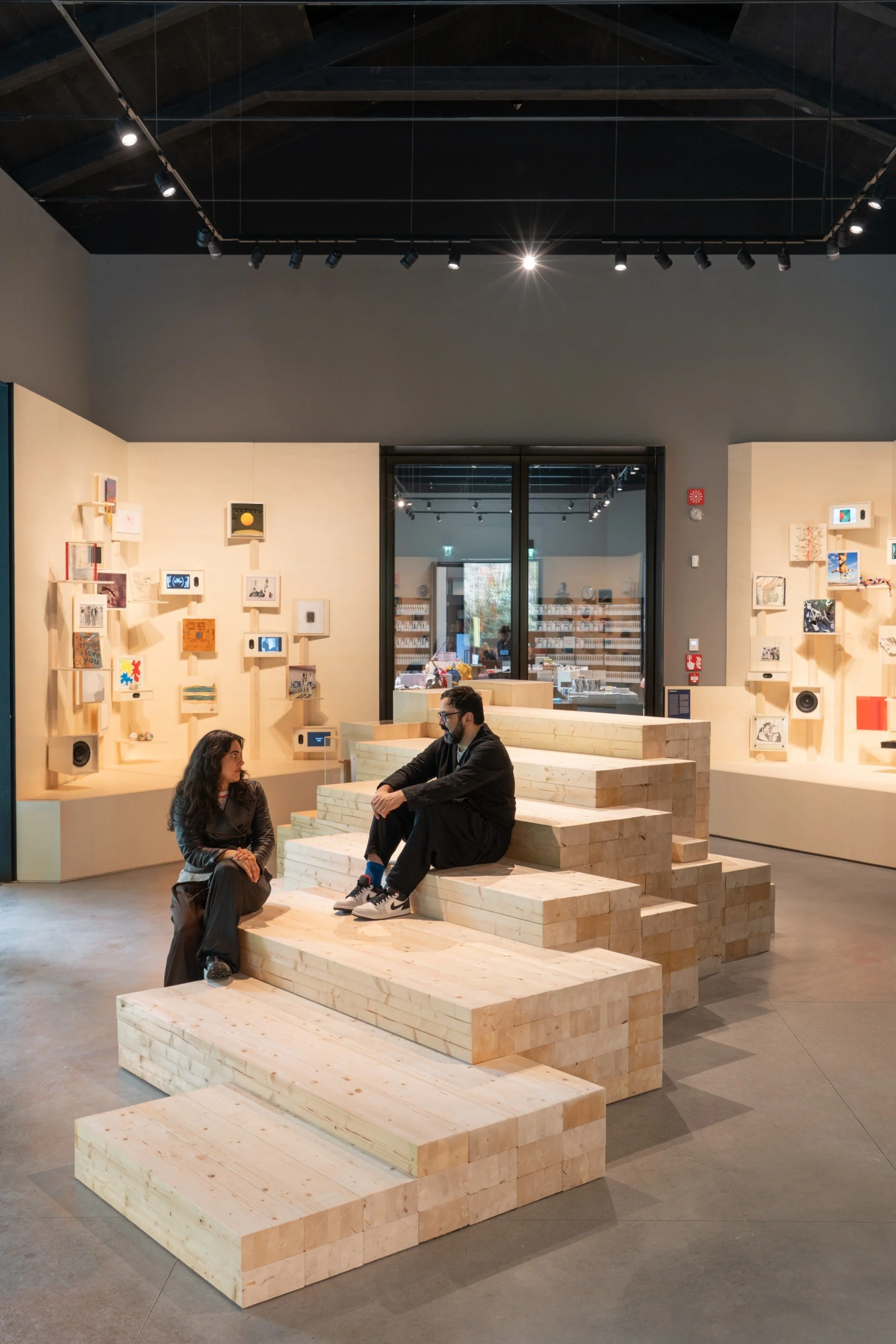
I attended the 61st Venice Biennale in support of my inclusion in Chimera, an installation by Denniston Hill, curated by Koyo Kouoh as part of In Minor Keys. More than 195 alumni were included in the exhibition, each contributing a work to a sprawling installation that mirrored the connectivity of the residency programme, the connections that happen when you attend, as well as the structure of the front porch.
As I was there during Vernissage week, I was able to preview the Biennale, attend other artists’ events, and contribute to an informal curatorial tour with other artists for a group of curators.
The opportunity to exhibit at the Biennale and attend in person was a pivotal experience, offering direct engagement with an international audience and context for my work at one of the art world’s most significant platforms. It gave me a deeper understanding of the Biennale’s scale and history, and the chance to see the work other artists were making. Spending time with curators was invaluable, as was meeting other artists.
With curator Koyo Kouoh having passed away, I found myself reflecting on the role of the curator. Her presence was felt throughout the exhibition, and she was even a subject in her own exhibition. It left me thinking about absence and presence.
Experiencing the Biennale during Vernissage week was incredible, full of contradiction, extravagance and dissonance. It gave me a firsthand understanding of the scale of the event and the politics of the art world, something that’s hard to grasp without being there in person. The German pavilion was a highlight, as was the Japanese pavilion, especially the artists’ wall text, and the architecture of the Biennale itself. It felt like I was in a real life version of Risk.
Being there during a Biennale marked by the jury’s resignation and a significant amount of political action also shaped my experience. It left me thinking about art as a form of soft power and diplomacy, given that artists are effectively “representing” their countries, and about the role of protest, particularly at this scale, when you live in Aotearoa. I also thought about social media storytelling versus the in-person experience.
Managing accessibility was a key challenge throughout the experience. Despite this, attending in person created invaluable relationships and a deeper understanding of the Biennale, its context, and the wider art world.
I’m now working towards some activities in 2027. My advice to anyone invited to a similar programme is that attending in person always creates invaluable relationships and that it’s important to take up these opportunities when they’re available to you.